
By Matthew Cimitile, University Communications and Marketing
This calendar year showcased the vital role USF St. Petersburg continues to play in addressing the education and workforce development needs of the Tampa Bay region while conducting research that has national implications and global significance.
Throughout the year, students, faculty and staff showed tremendous resilience achieving the core mission of the university while still recovering from the impacts of the 2024 hurricane season, even turning the experience into a greater understanding of and preparedness for extreme storms. Programs enhancing educational opportunities for students, business executives and lifelong learners launched and expanded. Research activities are tracking the long-term impacts of digital media on individual wellbeing and the high risk and occurrences of human trafficking in the state. And thanks to state and scholarship investments, the campus is boosting education, research and higher education accessibility for years to come.
Providing a greater understanding of hurricanes and their impacts
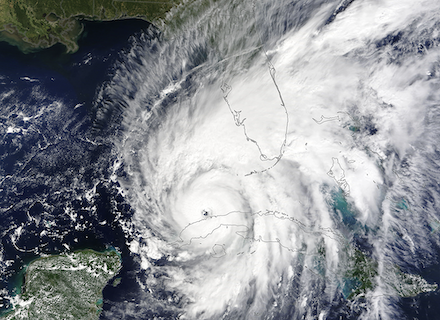
Image from NASA Earth Observatory.
Since the historic 2024 hurricane season, the most destructive in memory for Tampa Bay, researchers at USF St. Petersburg are working to better understand the power of these storms and the impact they have on land and on lives.
Two studies led by researchers with the College of Marine Science detail why certain hurricanes rapidly intensify. One such study showed that water discharged from rivers can play a role in this phenomenon. Data about freshwater plumes and how they can fuel hurricanes could help experts improve future forecasts. Another publication found that a ‘pressure point’ in the Gulf could drive hurricane strength. During Hurricane Ian, a strong ocean current called the Loop Current failed to circulate water in the shallow region of the Gulf. As a result, subsurface waters along the West Coast of Florida remained unusually warm during the peak of hurricane season in 2022, resulting in Ian’s rapid intensification.
On land, a new flooding app launched right before Hurricane Helene has now become a critical tool in helping local communities monitor and respond to extreme storms. The Community Resiliency Information System (CRIS) HAZARD app utilizes crowdsourced photos and artificial intelligence to track flood conditions in real time to help residents identify potential dangers. While a historian who grew up in the bay area is lending her professional expertise to help her community. Through a hurricane oral history project, stories of loss, transformation and hope are being preserved to document a myriad of experiences by those impacted by the 2024 hurricane season.
Survey reveals how smartphones may benefit kids, risks of posting publicly to social media
“We expected to find that smartphone ownership is harmful to children. Not only was that not the case, most of the time we found that owning a smartphone was associated with positive outcomes,” - Justin D. Martin, lead researcher.
A study of young people’s digital media use revealed surprising results, including evidence that smartphone ownership may actually benefit children. The study from USF researchers in journalism, psychology, public health, political science and communications also suggests a link between social media posting and various negative outcomes, as well as data connecting cyberbullying to depression, anger and signs of dependence.
The Life in Media Survey surveyed more than 1,500 11-to-13-year-olds in Florida. These findings will help inform a 25-year national study that will track young people’s digital media use and wellbeing into adulthood, with the goal of determining how digital media impacts and changes attitudes, behaviors and health throughout people’s lives.
Saving a life on campus part of student's journey to graduation
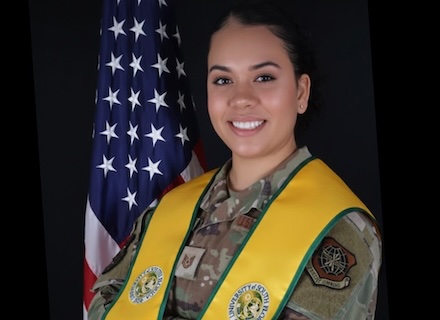
When Teresa Booker crossed the stage to receive her bachelor’s degree in health sciences, she not only celebrated a lifelong goal but reflected on a moment when her military training helped prevent a tragedy on campus. As Booker walked to class on a Tuesday morning in February, she heard a call for help. A 67-year-old man was having a cardiac emergency outside The Campus Grind.
Booker, a 13-year Air Force veteran and trained CPR instructor, quickly stepped in to help. She immediately began CPR, keeping the man stable until emergency responders arrived, were able to revive him and take him to the hospital. The man survived and still visits The Campus Grind today.
Building on Deepwater Horizon research, marine scientists target pollutants in Tampa Bay and beyond
Out of the scientific response to the Deepwater Horizon disaster, College of Marine Science researchers learned a lot about contaminants of concern and acquired highly specialized equipment to track their impact. That has led to the Tampa Bay Surveillance project, which is examining contaminants in Florida’s largest estuary, with the goal of identifying sources of contamination and helping prevent pollution.
A team of researchers has installed 17 racks across Tampa Bay designed to attract barnacles. By extracting soft tissue samples from barnacles, as well as samples from oysters, fishes, water, and sediments, they hope to make clear the complicated state of contamination in Florida’s largest estuary.
State and scholarship investments to further education, research and support
"EOS represents a transformational investment that will help us better prepare for extreme weather and strengthen our response to environmental challenges, creating more resilient coastal communities and economies," - Thomas Smith, USF St. Petersburg interim regional chancellor.
USF St. Petersburg received significant investments during the 2025 legislative session that will boost education, research and higher education accessibility for years to come. The campus’ Environmental & Oceanographic Science (EOS) Research and Teaching Facility received $10 million this year, adding to $24.3 million that the state funded back in 2023-24. The facility will serve as the heart of an interdisciplinary center of excellence, bringing together expertise from across the university to study and address coastal and environmental challenges.
The state also provided $1 million to support the Eileen Hoffman Hafer UMatter Program. The program provides students with intellectual disabilities the opportunity to experience higher education and campus life. The new funding will allow UMatter to expand enrollment and upgrade facilities, ensuring even more students benefit from its transformative opportunities.
To add to this support from the state, for the first time in campus history, USF St. Petersburg awarded over $1 million in student scholarships. This milestone marks a more than 20 percent increase from the previous year and a shared commitment to reducing student debt while supporting educational goals.
Expanding nursing education with new bachelor program
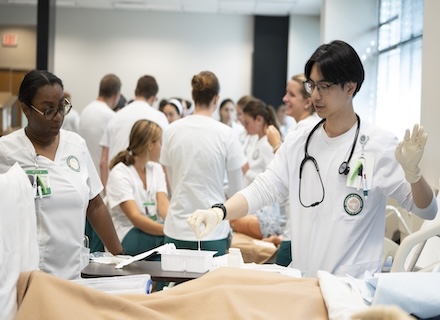
Florida is expected to face a shortage of nearly 60,000 nurses by 2035, according to the Florida Hospital Association. To address this growing concern locally, the University of South Florida is further expanding nursing education in St. Petersburg.
Starting in the fall of 2026, the USF College of Nursing will offer a four-year bachelor's degree program on the St. Petersburg campus for incoming freshman. The Freshman Nursing Pathway program will allow as many as 85 students per year to start preparations for a nursing career immediately upon entering their college career. And it will prepare students to become nurse generalists and to take the National Certification Licensure Exam to become registered nurses.
Groundbreaking report on the high prevalence of human trafficking in Florida
“We believe this annual report will make a substantial impact on anti-trafficking efforts, resulting in adults and children being spared from the devastating consequences of human trafficking and survivors receiving safe and effective assistance,” - FL. State Senator Darryl Rouson.
A first-of-its-kind report commissioned by the state of Florida shines a light on the high risk and occurrences of human trafficking in the state as well as the growing, coordinated response to combat the crime and aid victims. “The 2024 State Report on Human Trafficking” estimates that more than 500,000 people were exploited in labor trafficking and 200,000 in sex trafficking within the state in the last year. Minors are estimated to make up half the population being sex trafficked and one-fourth of those involved in labor trafficking.
Though signifying one of the highest rates in the country, the report by the USF Trafficking in Persons (TIP) Risk to Resilience Lab also details how the state is working to disrupt this criminal activity through prevention, protection, prosecution, policy and partnership efforts.
Florida’s oyster crisis takes center stage in latest musical-science project
A team of professors, musicians and students at USF is transforming complicated environmental data into powerful music compositions. After tackling critical issues such as harmful algae blooms and red tide, the group has composed music that highlights the environmental stressors affecting oysters in Florida.
The project aims to make scientific data more accessible, understandable and engaging to the public.
Launching a 'bold vision' for new Center for Executive and Leadership Education
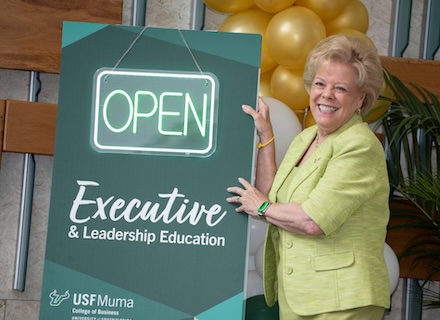
The Muma College of Business launched a new Center for Executive and Leadership Education, offering national-caliber leadership training to corporate leaders and executives in the Tampa Bay region.
With global corporate training spending surpassing $360 billion annually and leadership development ranked as a top organizational priority, the center will act as a critical bridge between academic knowledge and business practice. It will fill a regional need for high-level leadership education and custom corporate training programs and is supported by a $3 million gift from Kate Tiedemann and Ellen Cotton.
Composting initiative to reduce food waste and support urban agriculture
“The City of St. Petersburg is honored to participate and contribute to a program that actively reduces air pollution, fosters industry growth and creates opportunities for our residents and students,” - Maeven Rogers, City of St. Petersburg sustainability and resiliency director.
A new partnership between USF St. Petersburg and the City of St. Petersburg will bring an industrial-sized composter to campus to process food waste and produce nutrient-rich compost for the community. The initiative’s aim is to redirect tons of food waste each year from landfills, incinerators and sewage systems and create compost for community gardens, urban farms and landscaping. The partnership received a $350,000 grant from the U.S. Department of Agriculture Composting and Food Waste Reduction program.
What will start as a sustainability project to reduce food waste from the campus’ dining facility in the first year, is expected to expand to a sustainable business that collects and processes waste from local partners and sells back compost to the community. Potential collaborators include farmers markets, restaurants and urban farms.
Lifelong learning program launches classes in St. Petersburg
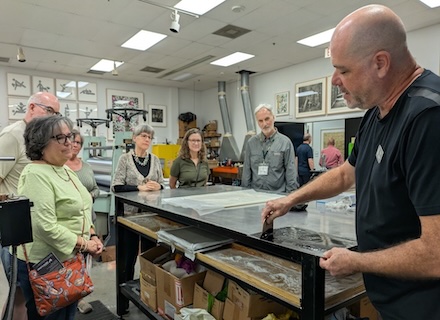
A popular adult learning program that offers classes, workshops and lectures targeting individuals aged 50 and older launched at USF St. Petersburg. The Osher Lifelong Learning Institute (OLLI) is a member-based learning community that provides high-quality, low-cost learning opportunities for seniors in their communities.
During the spring semester, the campus hosted five classes covering history, art, marketing, biology and an introduction to craft brewing. In the fall, that number doubled, with courses on storytelling, history, international politics, love, happiness and more from faculty and community experts.
Keys Marine Lab welcomed 1,050 coral babies to help restore Florida’s reef
Florida’s Coral Reef experienced significant damage during a mass bleaching event in 2023, but recovery are restoring this vital ecosystem. Earlier in the year, nearly 1,050 coral babies spawned and raised at The Florida Aquarium were delivered to the Keys Marine Laboratory (KML) in the Florida Keys. The lab is operated by the Florida Institute of Oceanography at USF.
Biologists and volunteers from the Florida Aquarium’s Coral Conservation and Research Center packed and loaded young elkhorn corals into coolers and drove them six hours. At the KML site, they were transferred into temporary tanks to become acclimated to seawater before planted on the reef or nurtured in ocean-based nurseries.