By Sarah Sell, University Communications and Marketing
A new anthropology course gave students a fresh way to think about happiness and offered a rare opportunity for two generations to learn side by side.
Happiness: Finding Meaning and Wellbeing through Cross-Cultural Perspectives paired undergraduates with members of OLLI, the university’s lifelong learning program for older adults, to explore what it means to live a good life.
“Anthropology lets us reflect on our own ideas of happiness by seeing how other cultures and generations experience joy,” said Heather O’Leary, a USF Associate Professor of Anthropology who taught the class.
Eager to build international wisdom into the classical perspectives, O’Leary designed a class that goes beyond psychological research to examine happiness through an anthropological lens. She expanded the model globally by inviting students from the Philippines to join through USF’s Virtual Global Exchange Program. Meeting virtually, students from USF and the Philippines compared how happiness is understood in their respective cultures.
“Psychology focuses on surveys and averages, but anthropology is about lived experience,” O’Leary explained. “Different cultures define happiness in different ways. Finland’s version isn’t the same as Italy’s, and neither looks much like America’s.”
Students approached the topic like anthropologists, conducting community observations, reflecting on their own lives, completing oral history projects and analyzing everyday rituals that shape wellbeing. Their findings were shared in class presentations throughout the semester.
“Not everything is about numbers and data. I like that we’ve been able to explore science in a more qualitative and participant-observant kind of way,” said Violet Thomas, a psychology major.
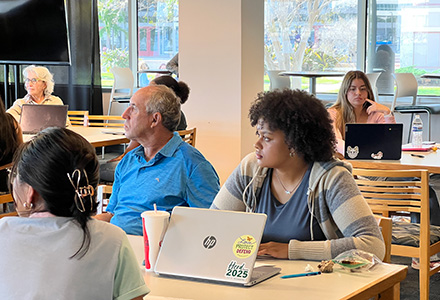
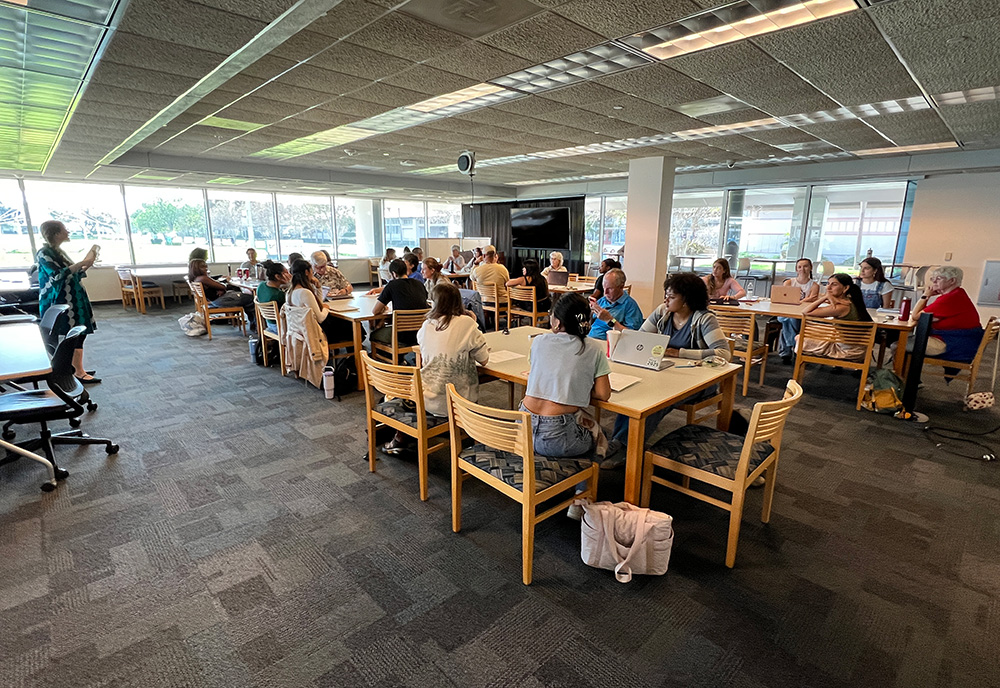
Students from USF and the OLLI participants worked side by side during the interactive happiness class.
OLLI members participated in three of the classes throughout the semester. They joined USF students on campus for candid, intergenerational conversations.
“I recently retired from accounting, and I’m trying to find a path for this next chapter of my life,” said Mary Petzen, an OLLI member. “I spent much of my life driven by goals and purpose. Now, I just want to be happy.”
Students said those discussions across the generations helped break down their own assumptions about age.
“Talking with someone older, you realize we have more in common than you think,” said Estela Najera, a sustainability major. “You think you are so different, but we connected over everything, even not liking to cook or clean. You gain wisdom from both sides.”
For the OLLI members, the exchange sparked memories of their own college years, both the challenges and the enjoyment.
From these exchanges across generations and culture, O’Leary hopes her students gain and take a long-term perspective to heart.
“My students come in understandably wrapped up in chasing success and imagining their next big career moves that they can't appreciate where they are right now,” she said. “Using cross-cultural ideas to examine each chapter of life as potentially the best years of life is a beautiful and crucial life skill.”
By the end of the semester, students reported feeling more grounded in the present, and OLLI members said they left feeling energized by the exchange. Together, both groups walked away with a clearer sense of what a meaningful life can look like at any age.