By Arielle Stevenson, University Communications and Marketing
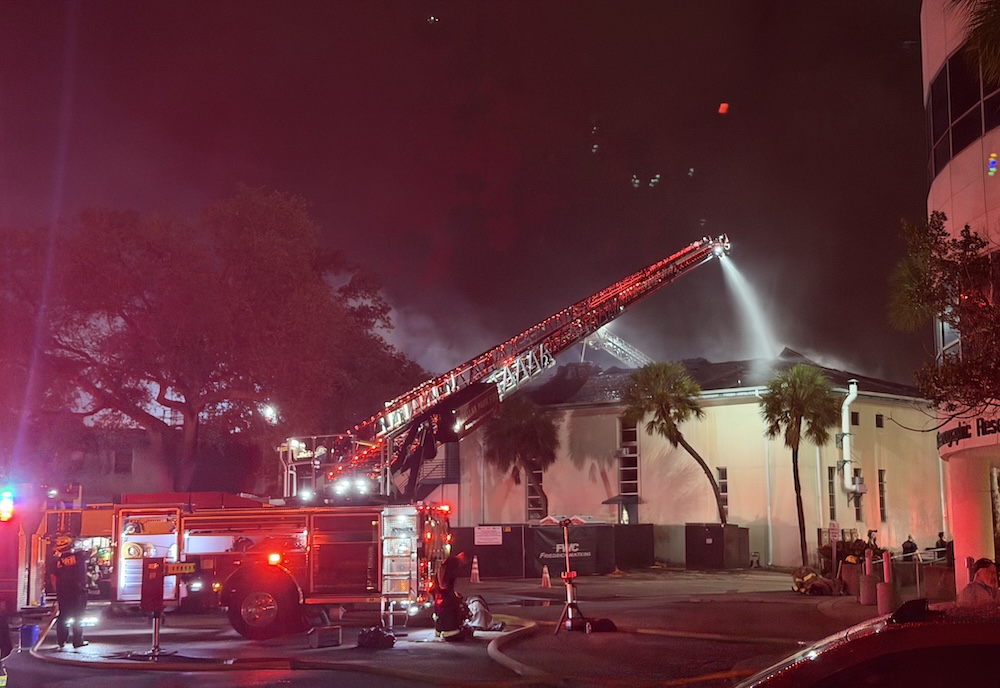
A storm blew into St. Petersburg on a Saturday afternoon as Tom Frazer worked at his desk at the USF College of Marine Science. He watched the storm roll in, recalling seeing a lightning strike a little after 3 p.m., followed by a massive downpour.
He texted a friend: “It’s deteriorating rapidly here."
Frazer, dean of the college, waited for the rain to let up and left campus a little before 5 p.m. He was heading home when someone called to tell him the college’s research facility next door to his office was on fire.
“I never made it home,” Frazer said.
By the time Frazer arrived back on the USF St. Petersburg campus, first responders were on scene.
The 80,000-square-foot Marine Science Laboratory, or MSL, built around an 87-year-old former maritime military training facility, housed critical work space for the College of Marine Science and the Florida Institute of Oceanography (FIO). More than 60 units and 200 firefighters would ultimately respond to the blaze, making it one of the largest emergency responses St. Petersburg has seen, according to St. Petersburg Fire District Chief Michael Lewis.
Kevin Sullivan, the campus emergency and safety manager, was also making his way to the scene that evening after getting a call about the fire.
“I will probably never forget, as I drove downtown, I could see the column of smoke beyond the high rises,” Sullivan said. “I knew this was going to be a long night.”
Over the next several days, the university’s response would move from fire suppression, life safety and hazardous material assessment to research salvage and recovery planning. Firefighters and police managed the tactical emergency. Around them, university leaders began building the structure for everything else: accounting for people, identifying hazards, protecting research and determining what, if anything, could be saved.
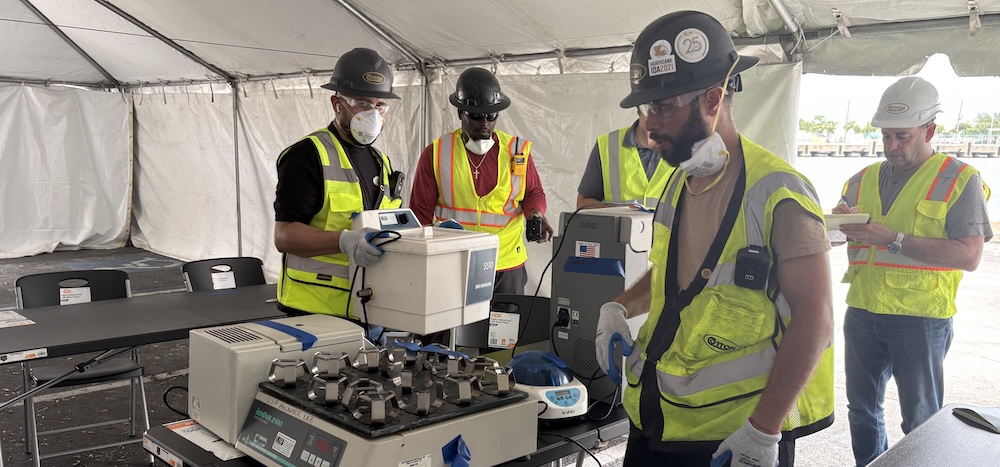
Crews worked to retrieve equipment from the MSL fire. Credit: Kevin Sullivan
People First
The first priority was people. That meant knowing if anyone was in the building and identifying the hazards first responders could face while protecting them.
Because MSL is a working research facility, the initial response required immediate information about what chemicals, laboratory equipment, stored samples and spaces could pose risks to first responders.
Frazer became one of the people helping responders understand the building. As fire and hazmat crews worked the scene, he and others helped identify what materials were inside, where hazards might be located and who might have had access to the building before the fire became visible.
A recent upgrade helped answer one of those questions. Frazer said the university had just installed key card access to the building, allowing officials to check who entered before the fire began.
Concern moved quickly through university leadership. Thomas Smith, USF St. Petersburg’s interim regional chancellor and vice provost of academic affairs, said the first concern of USF President Moez Limayem and others in university leadership was whether people were safe.
“What people wanted to know is, is everybody okay?” Smith said. “And I could say by 11 o'clock that night that yes, everybody was accounted for.”
For Sullivan, the response was guided by two principles he brings to every campus incident.
“Number one is nobody gets hurt,” Sullivan said. “Number two is how quickly can we get back to the primary mission, which is teaching and research.”
As life-safety and hazmat questions unfolded Saturday night, Sullivan promptly activated emergency management protocols to pull university leaders into the response. By then, the emergency had expanded beyond the fire scene. The university needed a way to coordinate.
“What people wanted to know is, is everybody okay? And I could say by 11 o'clock that night that yes, everybody was accounted for.”—Thomas Smith, USF St. Petersburg Interim Regional Chancellor
Building the Response
That structure took shape the same evening, before the flames were extinguished, when the Campus Response Team, or CRT, met for the first time. The team gathered again Sunday morning, in person and virtually through the Regional Operations Center, or ROC, at the USF St. Petersburg Police Department.
Firefighters and hazmat crews continued working at MSL, but the fire created too many questions for any one person, office or unit to manage alone. The CRT brought together leaders who could address the crisis holistically.
“The campus response team includes the key leaders across the campus that have responsibilities to execute,” Sullivan said.
For Sullivan, that structure came through emergency management protocols and the principles of the Incident Command System, a standardized approach used to organize complex emergency responses. It was a system he knew well from 20 years in the U.S. Coast Guard. That protocol is also well known to Mike Kahle, director of FIO, who became one of the key operational voices in the CRT. With more than 25 years of U.S. Coast Guard experience, including as commander of Coast Guard Sector St. Petersburg, Kahle, like Sullivan, was trained in incident command.
That background mattered as the university needed to know who had access to spaces, what building systems were affected, what resources were needed and what steps would keep people safe while work continued.
“At first you have everybody trying to do the right thing through their own lens,” Kahle said.
The work of the response structure Sullivan activated is to bring those lenses together into a kind of stereo.
By Sunday into Monday, the response had shifted from immediate reaction to organized coordination. The fire scene still belonged to the first responders, but the institutional response was becoming clearer. People were accounted for, hazards understood and communication streamlined, with a move towards identifying critical needs and what might be salvageable.
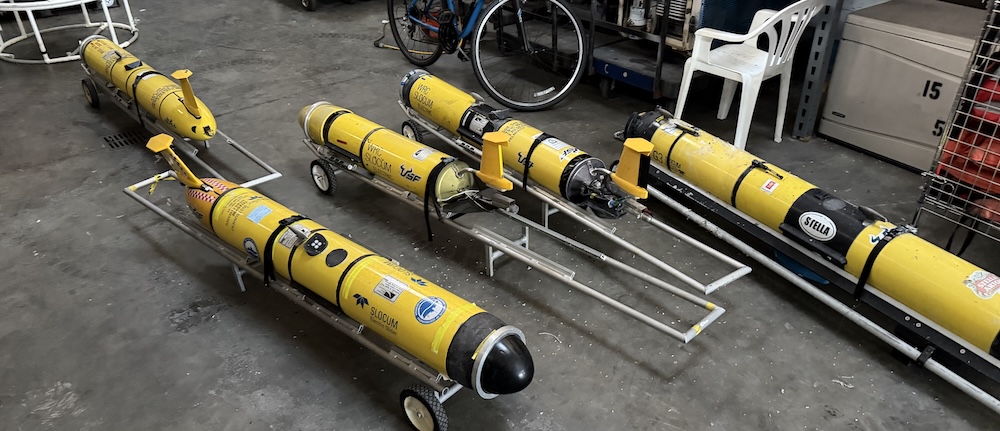
Efforts to recover vital equipment, research and specimens from the MSL fire scene were more successful than initially expected. Pictured here are gliders that collect data to understand ocean circulation, red tides, habitat and more. Photo credit: Kevin Sullivan
What Could Be Saved
Once people were accounted for and immediate hazards were addressed, another question
took shape: what could be saved?
MSL is a research facility filled with freezers, samples, servers, instruments, records,
data and materials tied to decades of scientific work. Some assets were vulnerable.
Some were time sensitive. Many were still inside a building affected not just by fire,
but also smoke, water, power loss and hazardous conditions. By Tuesday, the response
team still grappled with uncertainty.
At an all-hands meeting on Tuesday for faculty, students and staff, Frazer and Kahle delivered a difficult message: damage and hazards were so severe that getting back inside might not be possible at all.
“For some people, it’s their life’s work,” Kahle said.
The College of Marine Science is built around research, and much of that research depends on materials that cannot simply be replaced. Samples represent field work. Data supports ongoing projects, grants, publications and student research. Equipment is expensive, specialized or difficult to relocate.
Frazer understood these stakes.
“People are primary but we’re in the information business — samples and data are essential assets,” he said.
The recovery effort had the feel of triage: what was most urgent, what was most vulnerable and what could be reached without putting people in danger. This became the central tension that the CRT would navigate over the coming days.
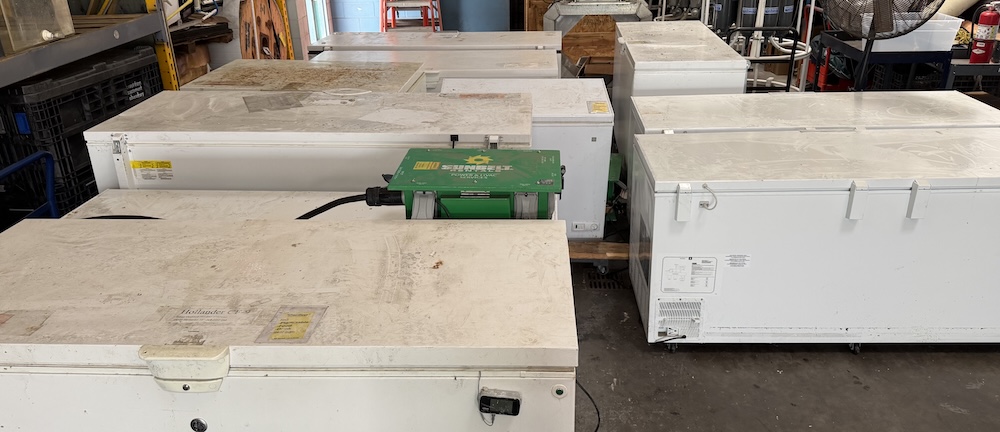
Freezers containing critical samples for research were recovered from the MSL fire. Photo credit: Kevin Sullivan
“What we needed to do is get to yes,” Sullivan said. “In a safe and effective manner.”
That meant not just asking whether someone would enter the building, but how a critical task could be done safely, with the right approvals, protective measures and people involved.
“Frozen samples were considered to be especially vulnerable because there’s no power,” Frazer said. “We needed to act quickly to retrieve those samples, but how do you gain access without getting people hurt?”
Questions got more specific. Over time, the group began to take on shared priorities.
In the days after the fire, there were signs of what had been preserved, in great part because of the teamwork of the CRT. Crews pulled 37 freezers from the building and much of the retrieved samples appeared to still be viable for research, Frazer said. Some samples dated back decades. There was the successful recovery of 11 critical servers, with 10 back online by Wednesday afternoon.
The CRT’s shift from “can we go in?” to “how can we do this safely?” redefined the trajectory of the initial response and shaped the recovery to come.
“What we needed to do is get to yes. In a safe and effective manner.”—Kevin Sullivan, Campus Emergency Manager
From Response to Recovery
By Thursday, the first phase of response had ended. The fire scene had become a recovery operation, and the CRT had given way to the Unified Command Structure, built for the longer road ahead. For Sullivan, the purpose of emergency management is to provide a structure for decision-making and facilitate it.
"My job is to provide a process and a framework,” he said. “So that the right people can make the right decisions with the right information at the right time.”
Many like Kahle, Frazer and Smith credit Sullivan’s implementation of that structure with the success of the overall response and recovery.
“Those first few days were very abstract,” Smith said. “But soon, we were pulling freezers out. Samples were viable. We got those servers. Pretty quickly, there was a way to see the path forward and that was extraordinary.”