
By Matthew Cimitile, University Communications and Marketing
The archaeological record shows that for as long as people have gathered in cities or conducted religious ceremonies, alcohol was present to promote social bonding.
Several years back, USF anthropologist John W. Arthur wrote a book tracing the history of beer going back nearly 13,000 years to its start in ancient civilizations. Now he is traveling to the source to expand on this work, conducting research and teaching in countries with some of the most ancient pottery and earliest known evidence of alcohol production.
He will do so as one of only a few USF professors ever awarded a multi-country Fulbright.
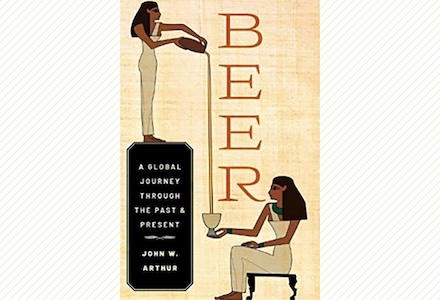
Published in 2022, “Beer: A Global Journey through the Past and Present" explores beer through archaeological and historical contexts.
“This is my first Fulbright, and like with other Fulbrighters, I was waiting on pins and needles to see if my proposal would get accepted,” Arthur said. “It was a sense of relief when I got the news, but then it was ‘Oh wow, my life is going to change quite a bit.”’
Over the next eight months, Arthur will examine ancient pottery in Spain and Greece for evidence it was used to prepare alcoholic drinks such as beer and wine. His research will explore what people drank, how they used pottery and the social settings in which those drinks were consumed.
Arthur will conduct research at sites such as Dikili Tash, the oldest known area for wine production in Europe. His Fulbright also includes teaching courses at the University of Valladolid in Valladolid, Spain and Aristotle University of Thessaloniki in Greece, where he will collaborate with faculty from both countries along with their students to foster international research partnerships.
“Fulbright multi-country awards are extremely difficult to obtain. The person must have a compelling case for being in both countries for the project, which is evident in Dr. Arthur’s research,” said Darlene DeMarie, the Fulbright scholar advisor for USF World.
Arthur hopes the Fulbright will deepen understanding into feasting and rituals from the Neolithic to the Bronze Age in Europe, while shedding light on how pottery evolved during this formative period in human history.
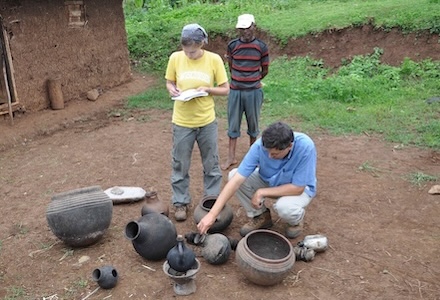
Arthur on fieldwork in Ethiopia. It was during a trip early in his career when he uncovered erosion within pottery caused by alcohol.
His interest in ancient alcohol production began during a two-year-long research trip to Southern Ethiopia, where he studied the relationship between pottery and food. While there, he noticed how many pots were eroded on the inside and asked locals why.
“They would always say that the beer was eating the pot. The lactic acids in the beer were eroding the ceramic material, which became a tell-tale sign of beer production in the archaeological record,” Arthur said. “This has now been documented by evidence across the globe. We can go to archaeological sites and see the same use-wear and erosion on these ancient pots in New Mexico, England and across mainland Europe.”
This experience spurred his interest in alcohol as a historical and cultural subject and eventually led him to write “Beer: A Global Journey through the Past and Present.” Published in 2022, the book explores beer through archaeological and historical contexts, including its impact on health, economy, religion and technological development.
Arthur also teaches in the USF Brewing Arts Program; an online certificate program focused on the science and business of craft beer. His course examines brewing through archaeology and Indigenous knowledge.
“For both wine and beer, it is a medium that brings people together and makes us converse,” Arthur said. “There is also a lot of meaning behind alcohol production that we find across cultures. You are taking grains or grapes and transforming them through fermentation. It is kind of a magical process.”