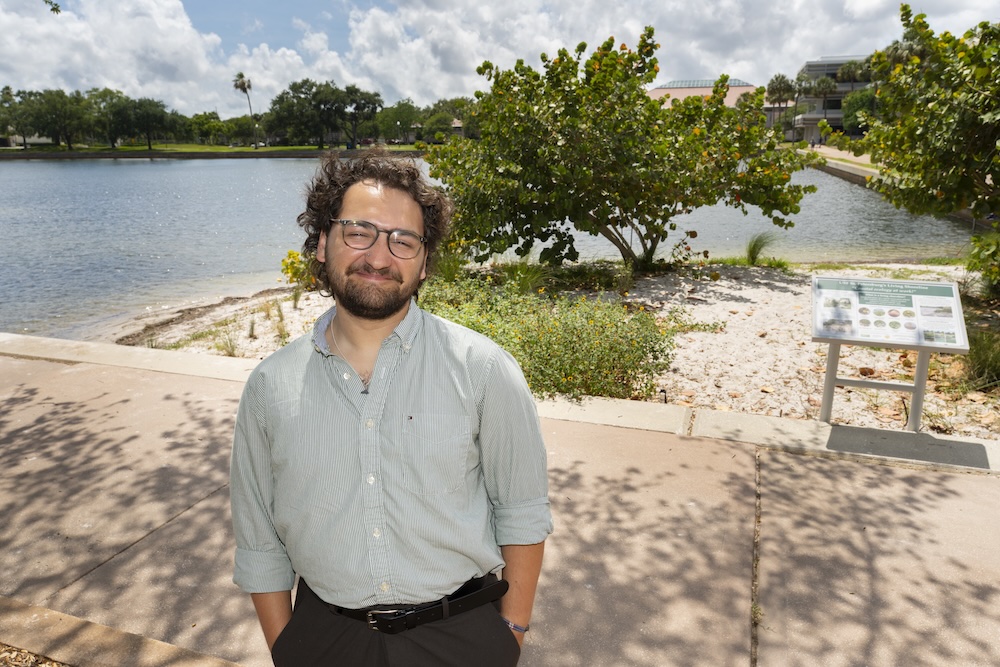
By Arielle Stevenson, University Communications and Marketing
Long before he began restoring shorelines along Bayboro Harbor’s waterfront, Oliver Laczko was raised learning how to observe the land and the water. Growing up in South Florida, Laczko spent time with his father and grandfather along Alligator Alley, watching the alligators move through the wetlands.
Those early experiences in and around the Everglades shaped what would become his academic focus.
“That was a big influence,” Laczko said. “Growing up around the Everglades is what really got me into wetland science.”
As he got older and had more freedom to travel on his own, that curiosity turned into exploration, with Laczko going deeper into Big Cypress National Park and the Everglades.
“I would take these really treacherous hikes through knee-deep water,” he said. “It was so life changing.”
Once he arrived as a freshman at the University of South Florida St. Petersburg, he discovered access to a wider range of Florida ecosystems that expanded his perspective beyond South Florida.
“Being here, you’re kind of in the middle of everything,” he said. “There's so much nature you can drive to that’s just a couple hours or even a couple minutes away.”
That access shaped his academic focus on environmental science and policy and ultimately led to work that would leave a lasting mark on campus.
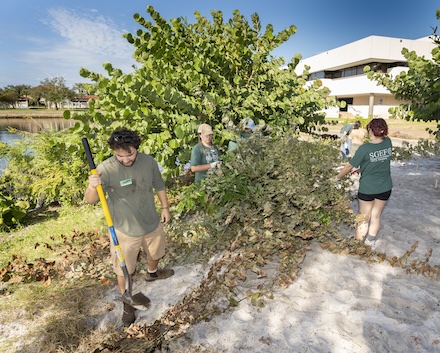
Around 30 student volunteers helped Oliver Laczko (left) rebuild a living shoreline along part of Bayboro Harbor in 2025.
A project to restore a living shoreline began with a simple observation by Laczko. In the wake of the 2024 hurricanes, a stretch of waterfront along Bayboro Harbor at USF St. Petersburg was left eroded and exposed. Earlier removal of invasive vegetation had already weakened the shoreline, with the storms further reshaping the shoreline. Laczko, who was already involved in campus sustainability efforts, saw an opportunity to restore what had been lost.
“I was like, OK, we need to restore this place,” he said.
As coordinator of sustainability for student government, and later as vice chair and chair of the Student Green Energy Fund, Laczko helped move the project from idea to reality. He wrote a grant proposal as a junior and secured funding to begin the restoration. After months of coordination with university administrators, he and about 30 volunteers installed marsh grasses and built a living shoreline designed to stabilize the coast and rebuild habitat.
“We were restoring some of the first marsh habitats in that area since its development in the 1900s,” he said.
The project now serves as both coastal protection and a visible example of student-led sustainability work. Signage based on Laczko’s Judy Genshaft Honors College thesis on Bayboro Harbor is expected to be installed along the waterfront this summer.
“It gets people interested,” he said. “It makes them want to make a difference because they see that it’s possible.”
Laczko's efforts helped increase student involvement and expand environmental initiatives, including a partnership between USF St. Petersburg and the City of St. Petersburg to bring an industrial-sized composter to process campus food waste and produce nutrient-rich compost for the community. New student groups have formed, and projects like the living shoreline restoration have created opportunities for hands-on learning.
“I hope there are other student leaders that eclipse the work I did,” Laczko said.
After graduation, Laczko plans to continue his work towards wetland sciences, restoration and resilience for Florida’s communities.
“There are so many possibilities,” he said.
Despite the myriad options that await him, one thing is certain: Florida remains central to his work and identity.
“Remember your roots,” Laczko said. “Don’t lose focus on that.”