By Arielle Stevenson, University Communications and Marketing
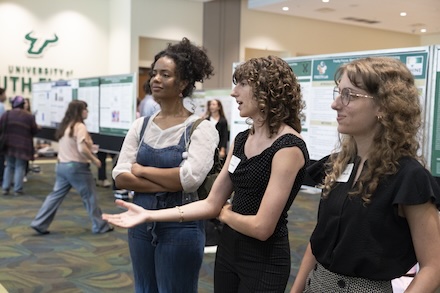
It was the culmination of months of work for more than 115 students presenting at USF St. Petersburg’s OneUSF Undergraduate Research Conference, held April 22 in the University Student Center Ballrooms. Students highlighted their research projects for the 2025-26 academic year at the 23rd annual event, sponsored by the Office of Student Engagement in Research and Innovation, which was also held in Tampa and Sarasota-Manatee.
John Johnson is Associate Director for the Office of Research, who co-sponsor the conference, and has been the staff sponsor for the conference since 2015. Johnson said there were 96 posters presented overall at this year’s USF St. Petersburg conference, with an additional 12 oral presentations.
“Most of my job is helping faculty apply for grants, so this is really different and cool,” Johnson said. “This allows me to work with students on the other side of the important things we do.”
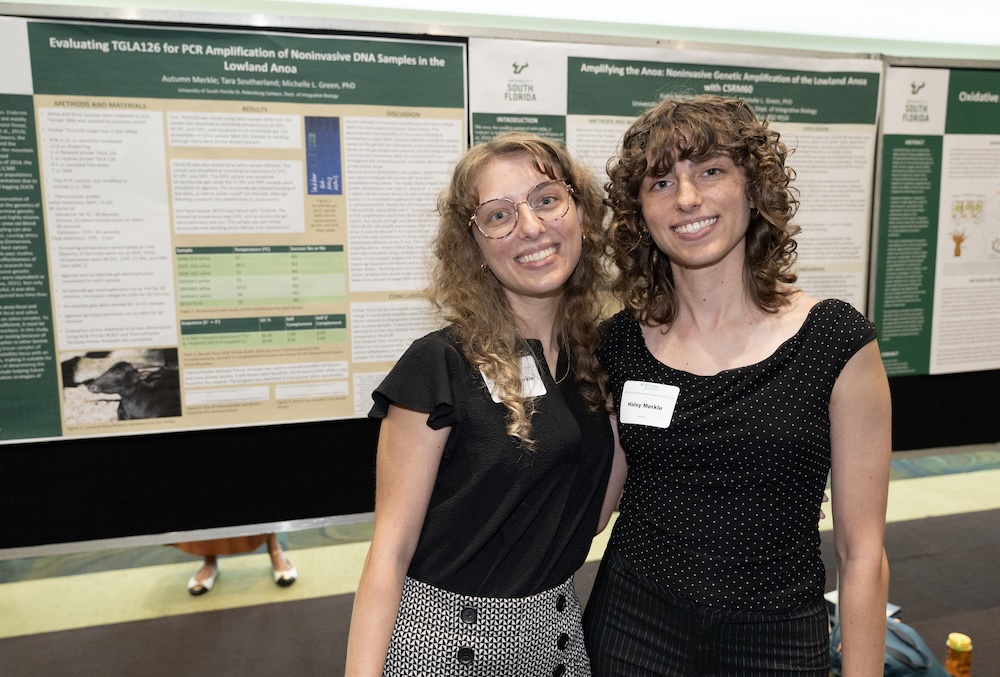
For sisters Haley and Autumn Merkle, it was a longtime love for animals that led them both to take part in a research cohort studying non-invasive DNA sampling conservation efforts.
Haley (left) and Autumn (right) Merkle worked together with a cohort to study non-invasive genetic sampling.
“We both always have had a love for animals since we were little,” Haley said. “One of our professors said ‘Hey, I have a research group I’m trying to run and it's about conservation genetics with the Anoa. We thought that was really cool.”
That professor is Michelle Green, Associate Professor of Instruction in the Department of Integrative Biology, who created the special research-based course in 2023. Her intent was to give biology and marine biology students the chance to do hands-on conservation research. Green first pitched the idea to ZooTampa about studying a species that was “of conservation concern.”
The Anoa, or dwarf buffalo, is endemic to Indonesia, meaning the species isn’t found anywhere else in the world. It is also endangered and its numbers are dwindling. ZooTampa suggested the Anoa and agreed to provide Green’s students with fecal and saliva samples from their two resident anoas for study.
The Merkle sisters signed up to work together to find ways to increase the population of Anoa.
“The target DNA we’re looking for will be used to identify individuals in the future,” Autumn said. “We’re trying to find ways to get their numbers up.”
Green said some students come into her course with a limited genetics background, while some come in with no background at all. That changes quickly over the course of the semester.
“By the time they’re standing with their poster, they’re feeling confident in their knowledge and have developed a really strong collaborative teamwork,” Green said. “It’s a fun activity in the ups and downs of research.”
Autumn's attempts to “amplify” DNA or replicate weren’t successful, but that unsuccess is useful information for future studies.
“It’s still important because now I can go back and say maybe don't use this primer in future research,” Autumn said.
Haley's results showed some success in amplifying the DNA when the temperature was adjusted. By working together, the Merkles were able to compare notes about their individual findings.
“We definitely bounced ideas off each other,” Haley said.
In the future, Green plans to put together all the findings from the cohorts for publication. The hope is that the research they’ve gathered over the past few years could help with the conservation efforts of the Indonesian Anoa.
“Seeing the work that previous scholars have done and building on that, that’s the essence of science.”
Michelle Green, Associate Professor of Instruction, Department of Integrative Biology
The sisters' research, along with the findings from the rest of the conference that ranged from algacidal activity in seagrasses to Indigenous poetry, will provide future students with a foundation to build upon.
“The idea is that they play one important role in this much larger project that is going on over years,” Green said. “Yes, it will ultimately be a publication for all of them, but seeing the work that previous scholars have done and building on that, that’s the essence of science."
The semester might be ending, but for many in the room at this year’s conference, their research projects are only the beginning.