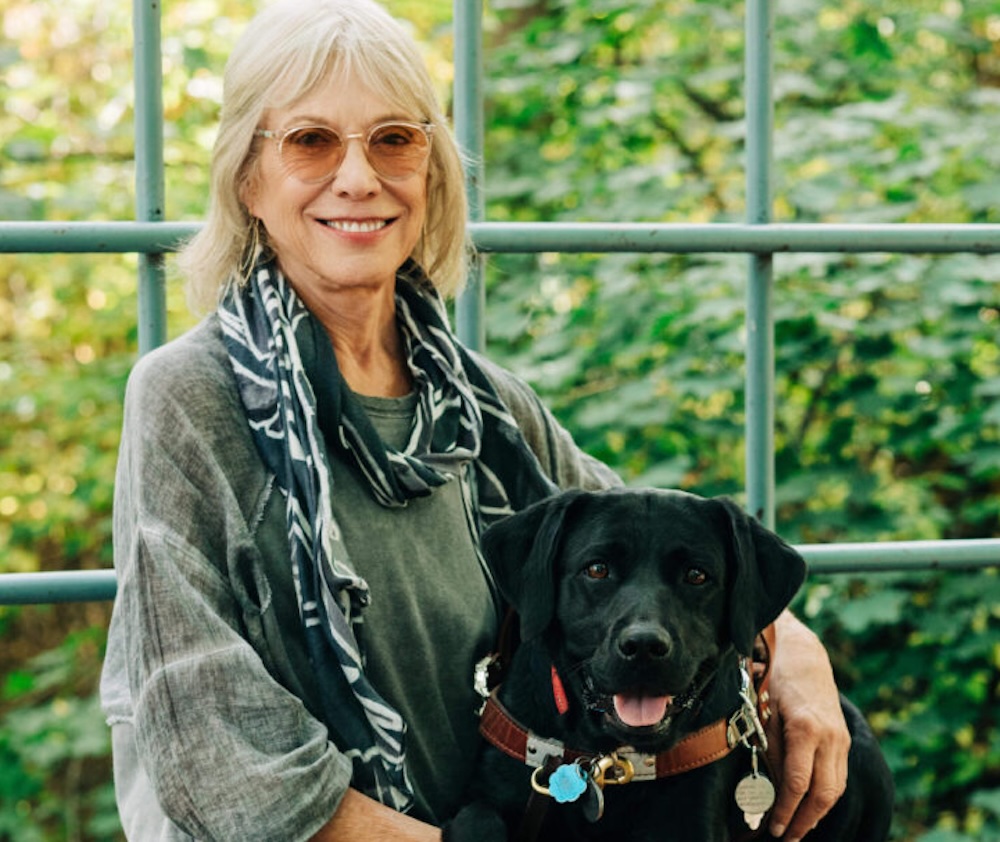
By Arielle Stevenson, University Communications & Marketing
When Deni Elliott arrived at the Guiding Eyes for the Blind campus in 2013, it was the first time she had been in a place designed entirely for the visually impaired. With her suitcase in one hand, and her white cane in the other — what she calls her “obstacle finder,” — she followed the instructor down the hallway.
Trail the right side of the hall, the instructor told her, so she wouldn’t run into people. Then they stopped outside of her room. The instructor told Elliott to reach her hand toward the door, where she would feel the raised room number beneath her fingers.
Elliott paused.
“I said, ‘I’m not that blind,’” Elliott recalled. “And she said, ‘Good for you, that you’ve got some residual vision. But here we assume that everybody’s blind and work from there.’”
This was a revelation for Elliott, who says she spent most of her life trying to compensate and adapt to the sighted world.
“I spent my life until then trying as best I could to pretend I was normally sighted,” she said.
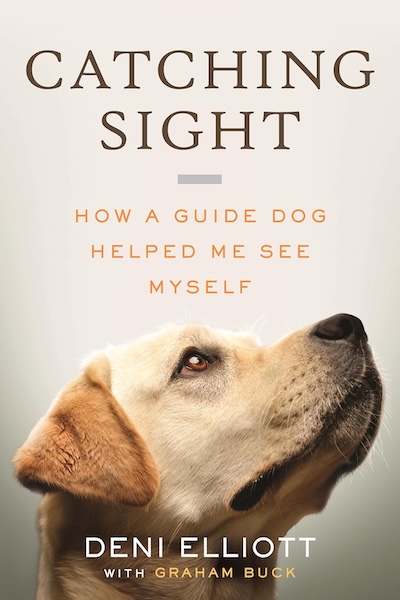
A few days later, Elliott met Alberta, the yellow labrador who would become the center of her new book, Catching Sight.
Elliott, who taught ethics at USF St. Petersburg for 20 years, is returning to campus on June 17 as part of the release of Catching Sight, her first memoir after a long career in academic publishing. The book traces Elliott’s experience with low vision and the complex partnership formed when a dog is trained to collaborate instead of simply obeying.
The experience she had on the Guiding Eyes campus changed her understanding of access. Alberta changed her understanding of trust.
Previously, Elliott had experienced guide dogs as helpers who led handlers around obstacles and warned them about curbs and stairs. Alberta showed her a trained guide dog could be a true partner, interpreting the world with and for the person holding the harness.
“She understood that she was the eyes at the end of the harness,” Elliott said.
Making that hidden relationship visible is one of the book’s goals.
“For just regular people who see a guide dog team, I want them to have a sense of the interspecies communication that’s going on in front of them, of the relationship, of the collaboration. There’s just so much happening that people don’t know.”
That communication begins long before the dog is matched with a handler, she said, through breeding, puppy raising and advanced training. Elliott learned from Graham Buck, her instructor at Guiding Eyes, who helped her work with Alberta. And when the harness went on Alberta, Elliott said, something changed.
“There’s something magical that happens when you put the guide dog harness on the dog,” she said. “The dog goes, ‘Oh, okay. Now I understand that we’re doing something entirely different.’”
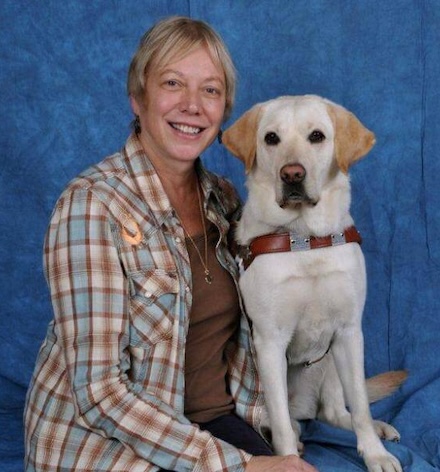 Deni and Alberta. Photo Credit: Guiding Eyes for the Blind
The early drafts of Catching Sight were originally titled, The Harness Effect, with Elliott initially imagining the project as a book on guide dog training. But as the project progressed over six years, it became something much more personal. She began interviewing family members about her childhood, the evolution of her low vision and her understanding of blindness as part of her identity, rather than something to hide.
“It wasn’t until I went to Guiding Eyes that it was safe to be blind,” she said.
The memoir form is new for Elliott, but she said the vulnerability it required connected with the work she had done for decades in the classroom. For years, Elliott has told students that they “had the power and responsibility to change the world,” and her job was to help them figure out how to do that. In Catching Sight, she turns her attention towards her own life and a partnership that allows her to move through it in new ways.
Ultimately, Elliott is asking readers to reconsider the guide dog team as two beings simply trying to navigate the world together.