By Arielle Stevenson, University Communications and Marketing
In the wet lab aboard the research vessel Falkor (too), Heather Judkins leaned over a large container of seawater and tiny, translucent animals from a part of the ocean most people will never see.
The animals had been collected with a Tucker Trawl, a net system used alongside ROV SuBastian, Schmidt Ocean Institute’s remotely operated vehicle. Once the animals came aboard, the science team sorted them by group before sending them for identification, imaging or genetic analysis.
“We are sorting everything out,” said Judkins, a marine scientist in USF St. Petersburg’s Department of Integrative Biology. “If there’s a crustacean, it goes into this jar. If there’s a jelly, we’re carefully pulling out a jelly so the jelly folks can look at it.”
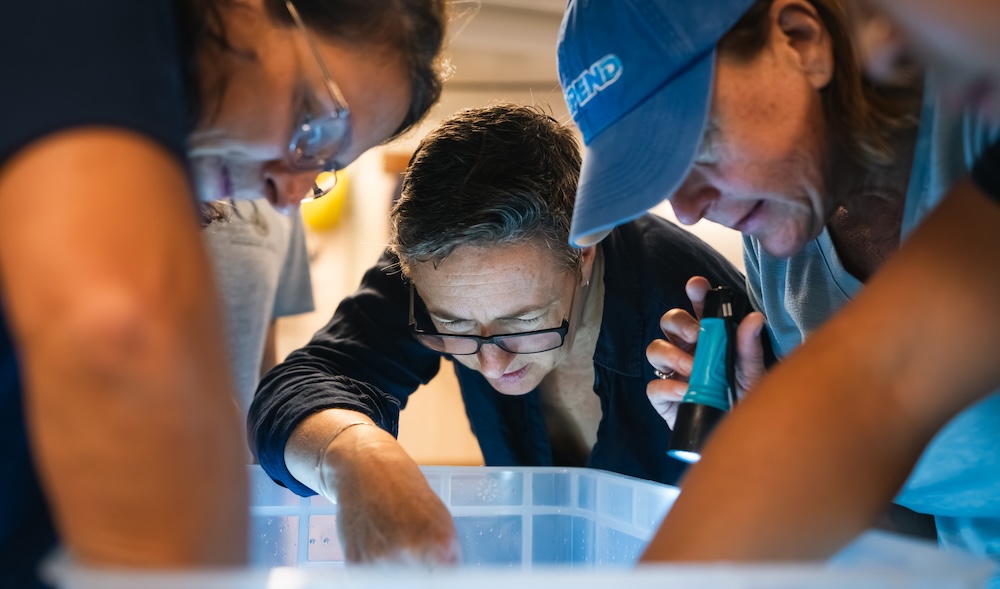 Dr. Karen Osborn (Smithsonian National Museum of Natural History–center) working with
Dr. Heather Judkins (University of South Florida, St. Petersburg–right) and Dr. Silvina
Botta (Universidade Federal do Rio Grande–left) in the wet lab of R/V Falkor (too),
collecting animals for further study. Credit: Schmidt Ocean Institute.
Dr. Karen Osborn (Smithsonian National Museum of Natural History–center) working with
Dr. Heather Judkins (University of South Florida, St. Petersburg–right) and Dr. Silvina
Botta (Universidade Federal do Rio Grande–left) in the wet lab of R/V Falkor (too),
collecting animals for further study. Credit: Schmidt Ocean Institute.
Judkins was part of an international Schmidt Ocean Institute expedition in the tropical South Atlantic, in waters off the coast of Brazil. Over two weeks, researchers aboard R/V Falkor (too) focused on the ocean’s midwater, the vast region between the sunlit layer and the seafloor.
By the end of the expedition, the team had identified 31 species believed to be new to science.
That included nine new species of jellyfish and seven new siphonophores, colonial animals closely related to jellyfish and coral. There were seven new comb jellies, known for the glittering cilia they use to swim and four larvaceans, tadpole-like animals that live inside mucus houses. The team also found an amphipod, a small crustacean related to crabs and lobsters; a fast-moving gossamer worm; and two giant rhizarians, single-celled organisms large enough to see with the naked eye.
For Judkins, one reason the team found so much was the expedition’s focus.
“We had two weeks of dedicated time to just midwater,” she said. “That was the highlight for me.”
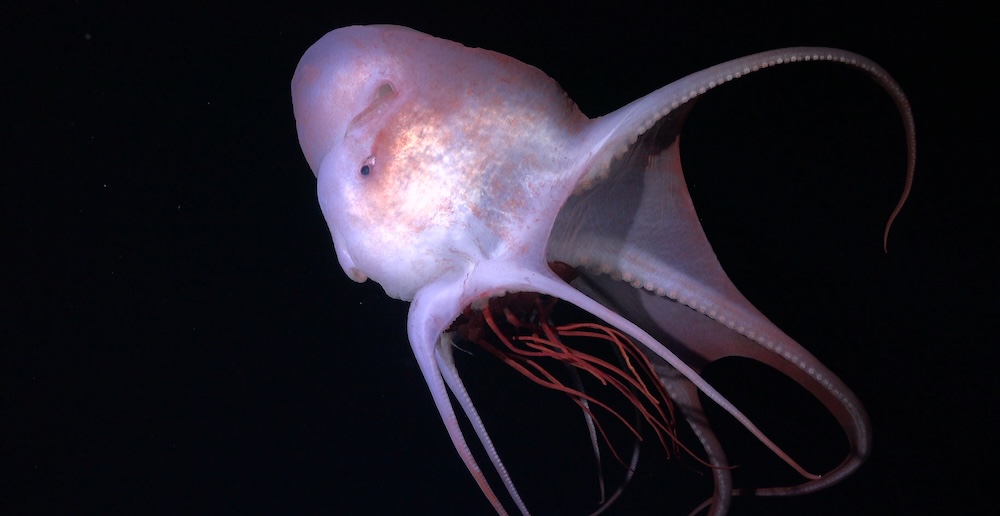
Credit: ROV SuBastian/Schmidt Ocean Institute.
Why the Midwater
Judkins, a cephalopod expert whose work focuses on squid, octopods and other deep-sea life, brought years of Gulf of Mexico research to the expedition. Through long-running deep-sea studies, she has helped document how squid, octopods and other midwater animals fit into ocean food webs.
The midwater is Earth’s largest habitable ecosystem, but it remains difficult to explore because of its size, depth and darkness.
Many of the animals the reside there are gelatinous, transparent and fragile. Some can be damaged by more traditional collection methods before scientists have a chance to study them.
Studying the midwater means studying the connections that keep ocean systems moving.
“There is this transfer of carbon, animals, food webs and nutrients moving up and down through the water column,” Judkins said.
That is why the expedition relied on multiple tools. ROV footage allowed researchers to observe animals in the water, while collected speciments could be studied more closely through imaging, identification and genetic sequencing. Advanced imaging systems also helped scientists capture details of shape and internal structures.
A glimpse of discovery
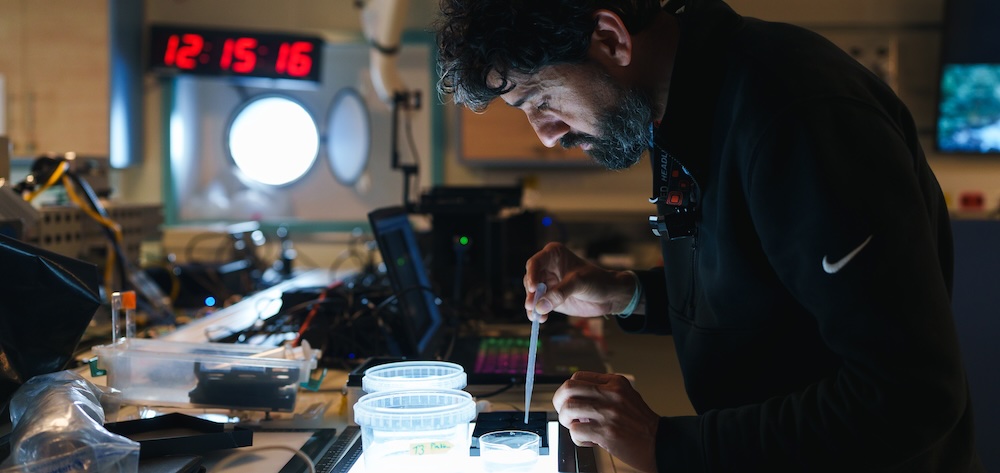
Dr. Manu Prakash (Stanford University) at work on R/V Falkor (too). Prakash’s lab developed a confocal microscope, used during the expedition, that provides image data to map out three-dimensional internal structures of tiny sea creatures. The expedition marked a first for seagoing research: scientists observed the living 3D-cellular structure of a microbe while at sea using this open-source microscope, opening possibilities for studying deep-sea physiology in real time. Credit: Alex Ingle/Schmidt Ocean Institute.
Photos from the expedition show Judkins and other researchers gathering delicate animals for further study. The images offer a rare look at how ocean discovery happens through careful observation, specialized tools and teams of scientists working together at sea.
Those discoveries are important because midwater animals help scientists understand how ocean communities' function and how carbon moves through the sea. The team also witnessed rarely seen moments like a glass squid and a pelagic octopus feeding on a bright red jellyfish at 800 meters below the surface.
For Judkins and the expedition team, the discoveries are reminders of how much of the ocean remains unknown.
“I think it’s hard to put a number on how much we’ve studied in our world oceans,” Judkins said. “But even if I’m going super optimistic and say 15% of the ocean has been studied, there’s still 85% of the oceans left to look at it.”
The ocean’s dark middle may be out of sight, but it is full of life. And for two weeks off the coast of Brazil, scientists helped bring a little of what’s hidden into view.